Culture Jamming as Critical Practice
http://www.teachingmedia.org/culture-jamming-as-critical-pedagogy-a-case-study-in-remix-media-studies/
Showing posts with label appropriation. Show all posts
Showing posts with label appropriation. Show all posts
Tuesday, December 13, 2016


Tuesday, March 10, 2015
Some collaged landscape examples
 This is a photo-collage from 1992 by the British artist Richard Hamilton titled, "Just what was it that made yesterday's homes so different, so appealing?" It combines color with black and white in an interesting way, making it possible to show many different kinds of images in a small space. He also plays with putting images outside the window and even on the ceiling.

 The two images at left are by the painter Alexis Rockman. He drafts his composition on the computer, and the way things are cut out resembles computer - based photographic technique. Here he tries to show images of how technological intervention in living processes might create monstrous results. Notice how he creates a sense of deep space through the use of a foreshortened horizon.
 These images are by the German artist John Heartfield and were made during the rise of the Third Reich in Germany in the 1930s. He was considered to be a pioneer of photo collage that appropriates images from other sources to create new meaning.


 Heartfield's work was a critique of Hitler's fascist government, and of all bigotry and ignorance. There are many more great pieces at this website. Take a look

 The above work by the Wisconsin artist Nicholas Lampert is influenced by the work of Heartfield through the use of appropriated images in photocollage, although to different ends.
 Here are some other takes on appropriation. While not a collage, this photograph by Dina Goldstein injects dark realism into the iconic figure of Sleeping Beauty. See this article about the image. from the article's caption, "Unhappy ending: Fallen Princesses, a project by Canadian photographer Dina Goldstein, shows iconic characters having succumbed to tragic fates, including cancer, alcoholism and unhappy marriages

Here is a simple example of an image using three layers. Look at how they are arranged to create a sense of depth in space, and perspective.
 This is a collaged portrait of a director of horror films, along with some his crew and actors. The red color tints everything in a gradient that intensifies at the back and bottom behind him. The other people are badly cut out against the background to give a jarring sense- of unease, like a horror film.


This is an illustration but it is created from the compositing of many similar kinds of scenes.
Saturday, February 7, 2015
Retro NASA Posters
The US space agency has created a series of striking travel posters inviting tourists to visit recently discovered “exoplanets”, including Kepler-16b, which orbits two stars:
Article in the Guardian

Article in the Guardian

Saturday, March 9, 2013
Short films from BMFF- Fallout by Paul Turano

LINK TO FALLOUT BY PAUL TURANO A short featured at the Big Muddy Film Festival. 4:30
what is the clicking sound?
what are the images from- is the artist making the animations? or are they being made some other way?
Monday, February 18, 2013
Sound in Chris Marker's Letters from Siberia
Also some clips from dialogue, Hunt for Red October
http://www.youtube.com/watch?v=-bm59rWJGCE
another
http://www.youtube.com/watch?v=PWU9g1Fce3U
Tuesday, February 12, 2013
Tuesday, February 28, 2012
Phototampering throughout history
How is photo tampering NOT the same thing as legitimate appropriation? Or is it?
the issue is whether this represented in a misleading way.
check out PHototampering throughout history
the issue is whether this represented in a misleading way.
check out PHototampering throughout history
Appropriation- Know what it is
"Appropriation is a word that is used by media artists to describe the visual or rhetorical action of taking over the meaning of something that is already known, by way of visual reference. For example, Andy Warhol appropriated the Campbell’s soup can visual identity to make large, iconic silkscreen prints. Warhol’s soup cans are an interpretation of the physical object. The visual reference to the original soup can is important, as the viewer needs this information in order to understand the idea that the reference conveys (your personal translation of this could range from a feeling associated with something as simple as a popular American icon or comfort food to repulsion at the commodification of domestic life). By transforming not only the size and graphic palette for portraying the soup cans, but also the place where the viewer will encounter them (an art gallery as opposed to a grocery market), Warhol appropriates the original Campbell’s soup cans to create art that relates to popular culture in its iconic form. Appropriation definition in Digital Foundations
Regarding usage rights, Appropriation falls into the category of fair use if several conditions are met. These include:
 This alteration of the Mona Lisa painting is a work by Marcel Duchamp
IT is called L.H.O.O.Q., is a pun, since the letters when pronounced in French form the sentence, Elle a chaud au cul. "Elle a chaud au cul" literally translates into "She is hot in the ass".[1]"

The appropration of logos is often used as a critique of commodity culture.
Warhol's soup cans are after something else- he was fascinated by reproduction and popularity as well as the idea of confusing the boundaries between what is thought of as high and low art.

this is by Johannes Wohnseifer:


Yasumasa Morimura is an artist who creates scenes that closely emulate famous paintings. Follow the link for more on him.

UN LOGO (above)-- below appropriated by Anonymous

thinking about SIGNS: What are the components of the new image (left)
Commenting on news: Original photo:
See more on Know Your Meme
Appropriating photographs to create new meaning:

 by Kenneth Tin Kin Hung
Regarding usage rights, Appropriation falls into the category of fair use if several conditions are met. These include:
- Nature of the derived work is substantially changed, or it is used to comment upon, criticize or to parody the original material. Such uses can include educational uses.
- The meaning of the work has been changed as it appears in the collaged work.
- Use of the appropriated material is not going to negatively impact the sales potential or value of the original material.
Read this overview of fair use in the NOLO Law Dictionary and then check out some examples.
Also see this page with several examples of still collages that use appropriated material.
Also see this page with several examples of still collages that use appropriated material.
 This alteration of the Mona Lisa painting is a work by Marcel Duchamp
IT is called L.H.O.O.Q., is a pun, since the letters when pronounced in French form the sentence, Elle a chaud au cul. "Elle a chaud au cul" literally translates into "She is hot in the ass".[1]"

The appropration of logos is often used as a critique of commodity culture.
Warhol's soup cans are after something else- he was fascinated by reproduction and popularity as well as the idea of confusing the boundaries between what is thought of as high and low art.

this is by Johannes Wohnseifer:


Yasumasa Morimura is an artist who creates scenes that closely emulate famous paintings. Follow the link for more on him.
.svg)
UN LOGO (above)-- below appropriated by Anonymous

thinking about SIGNS: What are the components of the new image (left)
Commenting on news: Original photo:
See more on Know Your Meme
Appropriating photographs to create new meaning:

 |
| This billboard was appropriated by graffitti artists who changed the perspective of the advert to that of the car.. |
Monday, January 16, 2012
 Civil Rights protesters attacked with firehoses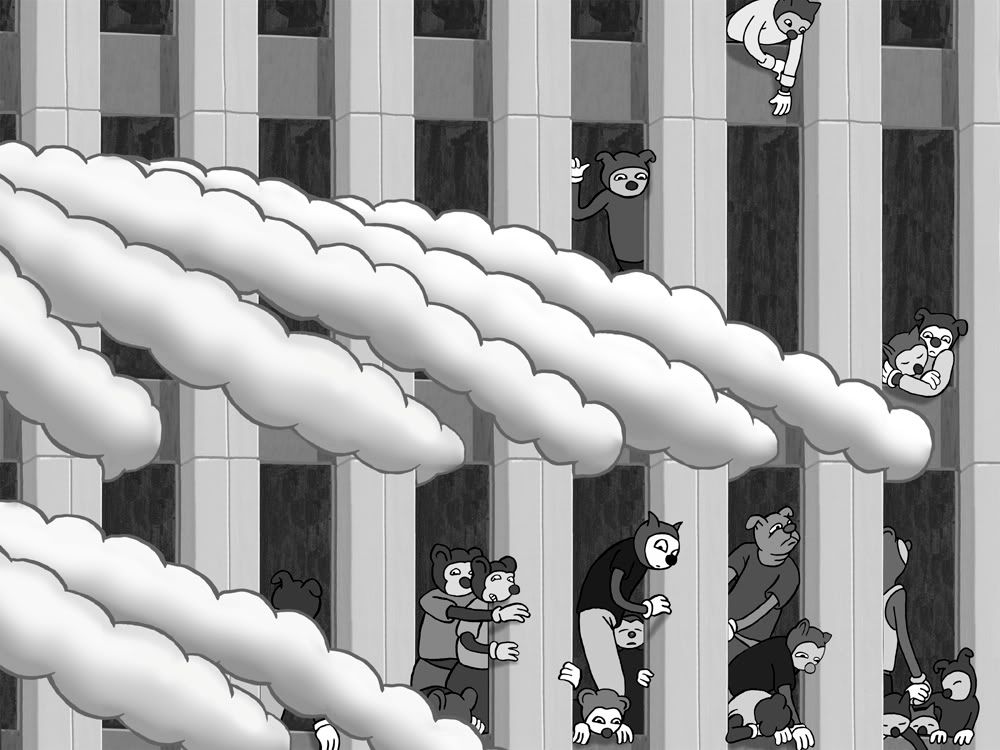
 Picnic Scene from the Sound of music
Tuesday, September 1, 2009


Subscribe to:
Posts (Atom)